
An eerie object photographed above Earth. Strange radio signals recorded before the Space Age. Claims of a satellite watching humanity for 13,000 years. The Black Knight satellite story has all the ingredients of a great UFO mystery—but do they belong to the same story?
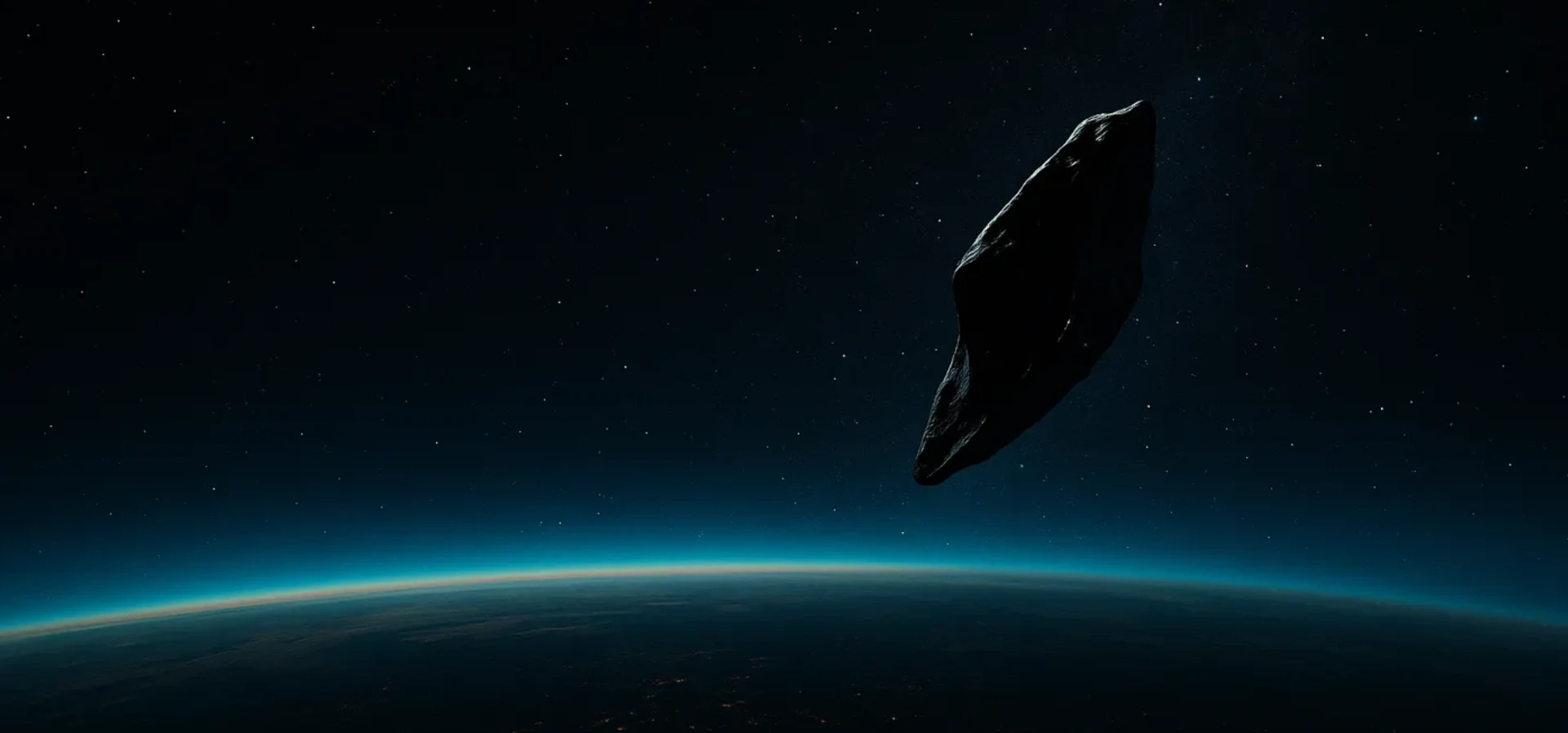
The Black Knight satellite mystery, sometimes called the Dark Knight satellite mystery, sits at the crossroads of space history, UFO speculation, and internet folklore.
According to its best-known version, an ancient extraterrestrial spacecraft circles Earth, silently observing our civilization. Supporters connect it to Nikola Tesla’s experiments, unexplained radio echoes, reports of unknown satellites before Sputnik, and striking photographs taken during a NASA shuttle mission in 1998.
Skeptics offer a different explanation: the legend combines unrelated events, and its most famous photographic evidence likely shows a lost thermal insulation cover.
So, is the Black Knight satellite real?
The fairest answer requires more than choosing between “alien spacecraft” and “fake.” The photographs are genuine. Some of the historical observations are genuine. What has not been demonstrated is that they document a single ancient extraterrestrial object.
To understand why the story remains compelling—and where its evidence falls short—we need to examine its pieces separately.
What Is the Black Knight Satellite?
The alleged Black Knight satellite is usually described as an artificial object of extraterrestrial origin traveling around Earth in a near-polar orbit. Popular accounts claim it has been here for approximately 13,000 years.
Its supposed purpose varies with the storyteller. Some describe it as an observation platform, others as a communications probe, and others simply as an abandoned alien spacecraft.
Those possibilities are intriguing, but they are interpretations rather than established findings. There is no verified construction date, recovered hardware, or independently confirmed transmission identifying an object as the Black Knight.
Even the name has an uncertain history. Discovery UK notes that the origin of the “Black Knight” or “Dark Knight” label is unclear. Crucially, the early observations later incorporated into the legend were not originally presented as sightings of a spacecraft bearing that name.
That distinction matters. A century-long history of one object would be powerful evidence. A collection of unrelated reports given the same label decades later is something different.
Sources: Discovery UK’s examination of the Black Knight story, Space.com’s historical overview.
1899: Did Nikola Tesla Receive Signals From the Black Knight?
Many versions of the story begin with Nikola Tesla’s experiments in Colorado Springs in 1899.
Tesla reported unusual electrical signals and considered the possibility that they represented communication from another world. Later accounts incorporated this episode into the Black Knight narrative, suggesting that he had intercepted transmissions from an alien satellite.
The connection is dramatic: a pioneering inventor detects a mysterious signal decades before humans begin launching spacecraft.
But the historical observation and the later interpretation must be kept separate.
The argument in favor
Supporters point out that Tesla’s experiments preceded the Space Age. If he received an artificial extraterrestrial transmission, a modern human satellite could not explain it.
That is a reasonable conditional argument. A confirmed intelligent signal from space in 1899 would be an extraordinary discovery.
The difficulty lies in the word confirmed.
The argument against
Tesla did not establish that the signals came from an object orbiting Earth. Nor did he identify a Black Knight satellite. That association was added later.
Several questions would need answers before the episode could support the modern claim:
- Was the signal external to his equipment?
- Was it produced naturally or artificially?
- Did it originate on Earth or beyond it?
- If extraterrestrial, did it come from an orbiting spacecraft?
An unusual pattern alone cannot resolve those questions.
There is also a caution for skeptics: the claim that Tesla definitely detected a pulsar is too confident. Space.com quotes a NASA Jet Propulsion Laboratory scientist questioning whether Tesla’s equipment could have detected pulsars and suggesting an Earth-based origin if the signal was genuine.
The responsible conclusion is that Tesla reported something he found unusual—not that he discovered an ancient alien satellite, or that its exact conventional explanation is settled.
Source: Space.com on Tesla’s signals and the Black Knight legend.
The Late 1920s: Mysterious Long-Delayed Radio Echoes
Another important ingredient comes from radio observations in the late 1920s.
Norwegian experimenter Jørgen Hals and other investigators reported what became known as long-delayed echoes: radio transmissions that appeared to return after unexpectedly long intervals.
These observations raised a genuine scientific question. Why would an echo arrive substantially later than expected?
For those interested in extraterrestrial intelligence, one possibility was especially appealing: perhaps something in space was receiving a transmission and sending it back.
Why supporters find the echoes interesting
A delayed response can suggest a relay. If a probe were listening to Earth, repeating our transmissions might be one way to attract attention.
Long-delayed echoes also provide the legend with something beyond a photograph. They introduce the possibility of behavior or communication.
However, this possibility is not the same as a demonstrated explanation.
Why the echoes do not establish an alien satellite
To identify an extraterrestrial relay, researchers would need evidence distinguishing it from radio-propagation effects, interference, or other causes.
An unexpected delay does not, by itself, reveal an intelligent sender. Even when an observation remains incompletely explained, that uncertainty does not identify its source.
This is one of the most important distinctions in the entire mystery:
A real unexplained phenomenon can become attached to an unsupported explanation. The reality of the first does not establish the second.
Source: Space.com’s discussion of long-delayed echoes.
Where Did the “13,000-Year-Old Satellite” Claim Come From?
The Black Knight’s alleged age is one of its most memorable features. It sounds precise enough to imply a scientific measurement.
But no physical object was recovered and dated to 13,000 years.
The figure is associated with a speculative interpretation of radio-echo data proposed by author Duncan Lunan in 1973. He suggested that the data could represent information from an extraterrestrial probe, including a star-map interpretation connected with Epsilon Boötis.
His proposal subsequently became entangled with the Black Knight story. Discovery UK notes that Lunan specifically rejected a connection between his work and the Black Knight satellite mystery.
The essential point is not whether the hypothesis makes an imaginative story. It is what the age claim actually represents.
It is not:
- A laboratory measurement of spacecraft material.
- A verified record of an object’s launch.
- A continuous tracking history extending into antiquity.
- An independently confirmed message stating the object’s age.
It comes from an interpretation of data—an interpretation that does not establish the age or existence of the photographed object.
When a speculative number is repeated without that context, it can gradually take on the appearance of a measured fact.
Source: Discovery UK on Duncan Lunan and the origin of the age claim.
1954: Were Unknown Satellites Detected Before Sputnik?
Another striking chapter concerns newspaper reports from 1954.
UFO author Donald Keyhoe claimed that the US Air Force had detected two satellites orbiting Earth. Sputnik, the first successful human-made satellite, would not launch until 1957.
At first glance, that sounds like major evidence. If artificial satellites were already circling Earth before known human launches, who put them there?
The answer depends on whether the original claim can be independently verified.
The strongest argument for taking it seriously
A reliably documented artificial satellite before Sputnik would deserve close investigation. The timing would make it historically important, regardless of whether its eventual explanation involved classified technology, observational error, or something more unusual.
Old newspaper reports can be useful leads. They preserve what people were claiming at the time.
The central weakness
A newspaper report establishes that a claim was published. It does not automatically establish that the claimed detection occurred as described.
A strong case would require authenticated observations, technical records, or enough tracking information for independent evaluation. The accounts reviewed here do not provide that level of substantiation for the alleged pre-Sputnik satellites.
That does not make archival investigation pointless. It means the report should be presented as a historical claim, not a confirmed discovery of extraterrestrial hardware.
Source: Space.com’s account of the 1954 reports.
1960: The Mystery Object That Had a Human Explanation
In 1960, reports of another unidentified object in orbit added to the material later absorbed into Black Knight lore.
TIME reported that the US Navy had detected a dark object initially suspected of being a Soviet satellite. Subsequent reporting identified it as debris associated with the American Discoverer satellite program.
This episode illustrates how an initial mystery can outlive its eventual explanation.
The first report is intriguing: an unknown object has been detected. The follow-up is less sensational: investigators have identified a human-made source.
When later retellings preserve the first part but leave out the second, a temporarily unidentified object can become a permanently mysterious one.
“Unidentified when first observed” does not mean “still unexplained after investigation.”
Source: Space.com’s review of the 1960 incident.
1998: The NASA Photographs Behind the Modern Legend
The most recognizable Black Knight evidence comes from STS-88, a space shuttle mission involved in the early assembly of the International Space Station in December 1998.
Photographs from the mission show a dark, irregular object against Earth. These images became central to the modern legend.
They are genuine space photographs. The disputed question is what they depict.
Accounts of the mission identify a thermal insulation cover lost during spacewalk activities as the explanation. Former NASA engineer and space historian James Oberg has connected the photographs with the documented loss and crew accounts.
Why supporters question the blanket explanation
The idea can initially sound unsatisfying. A dramatic space object is explained as something as ordinary-sounding as a blanket.
Some viewers interpret the outline as evidence of an engineered spacecraft and regard the conventional identification as too convenient.
There is a reasonable principle beneath that reaction: an explanation should be supported by evidence, not accepted solely because an authority offers it.
But that principle applies equally to the alien interpretation.
Why the thermal-cover explanation is stronger
The explanation does not depend only on visual resemblance. It has a specific mission context: a cover was reported lost during the same mission.
A folded insulation cover can present an unfamiliar shape. Harsh lighting, deep shadows, and changing orientation can make a lightweight object appear solid and mechanical.
A photograph alone also does not establish several crucial properties:
- Its true dimensions without reliable distance information.
- Whether its material is flexible or rigid.
- Whether it has propulsion.
- Whether it is performing controlled maneuvers.
- How old it is.
An unusual silhouette is evidence of an unusual silhouette—not, by itself, an ancient spacecraft.
Sources: Space.com on STS-88 and the lost thermal cover, Discovery UK’s review of the photographs.
Does Explaining the Photograph Solve the Entire Mystery?
Not entirely—and this is where a fair discussion should avoid overstatement.
Explaining the 1998 photographs does not identify the exact source of Tesla’s signals. It does not settle every question about long-delayed echoes. It does not replace careful examination of historical newspaper archives.
These are separate subjects.
However, that separation also creates a major problem for the Black Knight hypothesis. If the photographs, radio observations, and early satellite claims have no demonstrated connection, they cannot simply be counted as independent confirmations of the same object.
To establish that connection, researchers would need a bridge between them: matching orbital information, identifiable transmissions, consistent physical characteristics, or another reproducible link.
Without that bridge, the story remains a collection of episodes assembled into one narrative.
Is “Fake” the Right Word?
Calling the entire Black Knight story “fake” can obscure more than it explains.
There is a difference between:
- A fabricated image: a picture created or altered to depict something that was not there.
- A misidentified object: a real photograph interpreted incorrectly.
- An unsupported claim: a proposed explanation that lacks sufficient evidence.
- An unresolved observation: an event whose cause has not been established.
The famous shuttle photographs belong in a discussion of identification, not simply image fabrication. Tesla’s reported observations belong in a discussion of historical evidence and interpretation.
The ancient-alien narrative is unsupported, but that does not mean every underlying ingredient was invented.
This more precise language makes the subject easier to investigate—and avoids dismissing legitimate questions along with weak conclusions.
What Evidence Would Make the Black Knight Case Stronger?
The claim would become much more compelling if it produced evidence that independent investigators could test.
That could include:
Repeatable tracking. Different observers would need to identify the same object and predict where it would appear again.
Verifiable orbital information. A dependable orbit would allow researchers to distinguish the object from known satellites and debris.
Better physical observations. Images and measurements would need enough context to establish size, structure, distance, and movement.
Reproducible signal analysis. An alleged message should be recoverable through a clear method that other researchers can apply—not a one-off interpretation that depends on selective pattern matching.
A demonstrated link between historical events. If the claim is that Tesla, radio experimenters, Cold War observers, and shuttle astronauts encountered the same thing, evidence needs to connect those encounters.
The material examined here does not meet that standard.
That is not a demand for impossible proof. It is the difference between an interesting possibility and an established discovery.
Final Verdict: An Enduring Mystery, but Not a Verified Alien Satellite
The Black Knight satellite story survives because its ingredients are genuinely compelling: a visionary inventor, mysterious signals, Cold War uncertainty, and haunting photographs from orbit.
But a compelling narrative is not necessarily a connected body of evidence.
The strongest reasonable “not so fast” argument is that explaining the shuttle photographs does not settle every historical observation. Some questions can remain open, and an extraterrestrial probe is not something that can be dismissed merely because it sounds extraordinary.
The stronger counterargument is that no verified evidence ties these particular events to one ancient extraterrestrial satellite. The 13,000-year age is not a measured fact, the pre-Sputnik reports remain unsubstantiated, and the famous photographs have a well-supported explanation involving mission debris.
The most defensible conclusion is therefore straightforward:
The Black Knight is best understood as a modern space legend built around real observations, speculative interpretations, and a likely misidentified thermal cover—not a confirmed alien spacecraft watching Earth.
Remaining curious does not require accepting the legend. Remaining skeptical does not require pretending every historical detail is solved.
The productive question is not simply, “Do you believe in the Black Knight?” It is: Which specific observation are we discussing, what evidence supports it, and what would allow someone else to verify the explanation?