


Case: McMinnville UFO
Timeline: May 11, 1950
Location: Trent farm near Sheridan, southwest of McMinnville, Oregon, USA
Map: Sheridan area on Google Maps — approximate locality, not a verified farm pin
Type: DD
Classification: DD (Daylight Disc) (see about classification)
VCM: (Verg Credibility Matrix): 80%
Provisional editorial assessment
* Independent evaluative scores on separate 0–100% scales (do not sum to 100% because they are separate scores).
Case-claim credibility is not proof of an anomalous craft or alien origin. The explanation score applies only to the named candidate.
VAM: (Verg Abduction Matrix): N/A
Source: The Telephone-Register (June 8, 1950); William K. Hartmann’s Condon Report case study; Bruce Maccabee’s photographic analyses; competing suspended-model analyses. Linked research sources follow below.
Synopsis: Paul and Evelyn Trent reported seeing an unusual disc above their farm near Sheridan on May 11, 1950. In the account preserved by William K. Hartmann, Evelyn was outside feeding rabbits and called Paul, who retrieved the camera and took two photographs. Accounts place the sighting around 7:30–7:45 p.m. PST; the exposure time was not independently recorded and later lighting analyses dispute the evening account.
According to the Trents, Paul took two photographs of the metallic-looking disc before it moved away. The two exposures are the central surviving evidence; the reported motion, silence, distance and size depend on witness testimony rather than measurements from the photographs. Later retellings vary in their timing details, so an exact interval between exposures is not treated here as established.
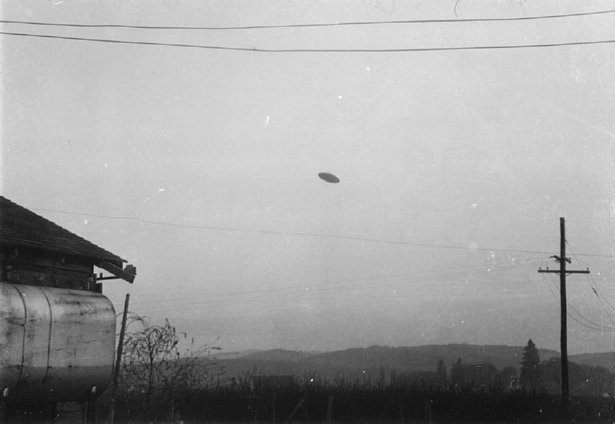
McMinnville UFO Photo
The local Telephone-Register published the photographs on June 8, 1950, under the headline ‘At Long Last—Authentic Photographs Of Flying Saucer???’. The question marks matter: this was a contemporary newspaper presentation, not a scientific certification. National circulation followed, including publication in LIFE, making the two pictures enduring icons of the flying-saucer era.
Several investigators regarded the photographs as genuine photographic records and found no persuasive evidence of a composite or retouching. That supports taking the images seriously, but ‘unaltered photograph’ and ‘genuine anomalous craft’ are different conclusions: a small object photographed in front of the camera would also appear on a genuine negative. The strongest dispute is therefore about the photographed scene and its geometry, not merely whether somebody edited a print.
The McMinnville photographs remain an unusually durable research case because two related film images, an early published account and later technical analyses can be compared. Repeated publication does not create additional independent witnesses, and unresolved questions do not by themselves establish extraterrestrial origin.
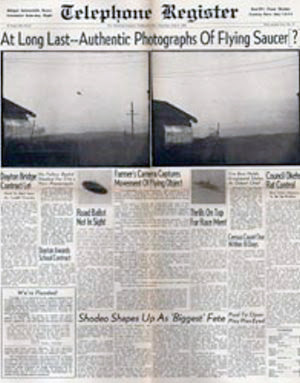
McMinnville UFO Photo appeared in the Telephone Register Newspaper
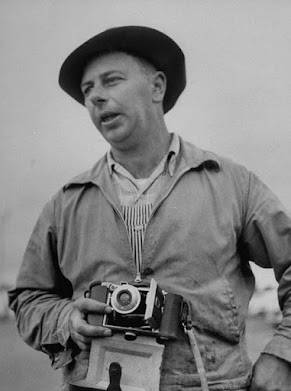
Trent with camera
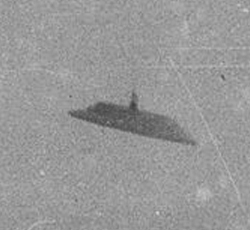
McMinnville UFO Photo Closeup of second photo
What the original photographic investigation found
William K. Hartmann examined the case for the University of Colorado’s Condon study. His case 46 report states: ‘The negatives had not been tampered with.’ He judged the two photographs to show the same physical object from different perspectives. These are important findings about film integrity, but they do not establish the object’s size, distance or origin.
Hartmann also examined the overhead wires and explicitly wrote that his tests did not rule out ‘a small model suspended from the nearby wire by an unresolved thread.’ Here, ‘unresolved’ means too fine to resolve in those images, not that he detected a thread. His analysis retained both a suspended model and an extraordinary flying object as unrejected interpretations. It should not be summarized as a government certification of an alien craft.
Why some investigators considered the case compelling
Physicist Bruce Maccabee revisited the negatives and Hartmann’s photometry. In his photographic study, he argued that the brightness of the object’s underside supported atmospheric scattering and a distant object, rather than a small nearby model. The reasoning depends on assumptions about surface reflectance, sky brightness and camera glare; it is a distance inference, not a direct range measurement. In his 2013 response to critics, he defended the case while acknowledging that photographic evidence alone could not prove it against a hypothetical perfect fake.
The Trents’ credibility, motive and publicity
Micha Verg regards the McMinnville case as high confidence and gives weight to the Trents’ perceived sincerity and lack of an established financial motive. The historical evidence offers some support for that view: Hartmann found it difficult to identify a prior motive for fabrication and described the photographs reaching a reporter through local contacts rather than an initial publicity campaign by the Trents. This is relevant witness context, not a guarantee that every detail of the account is correct.
In his historical account of the photographs, Maccabee reported no payment to the Trents for their use and no indication that they tried to capitalize on them. Hartmann nevertheless noted a subsequent trip to New York as a benefit of the publicity. The careful conclusion is that a payment or money-making motive is not established by these accounts—not that an audited lifetime financial history proves they never received any benefit.
The strongest competing explanation
A small suspended model is a substantive alternative because the object appears beneath overhead wires and its scale cannot be determined from two photographs alone. Robert Sheaffer’s lighting critique argues for morning rather than evening illumination and questions the atmospheric-distance inference. Joel Carpenter’s scene reconstruction examines framing and camera positions. These are competing interpretations, not an independently timestamped exposure or a witnessed fabrication.
A 2013 IPACO analysis by Cousyn, Louange and Quick favored a suspended model and reported a possible suspension thread in supplementary analysis. Maccabee contested the analysis and its reliance on print-derived values. This page therefore attributes the thread-detection claim rather than presenting it as a universally accepted finding. There is no new independent examination of the original negatives behind this update.
Provisional VCM review and next research steps
The provisional VCM review assigns 80% case-claim confidence and 45% plausibility for the suspended-model explanation. The higher claim score reflects the early record, the genuine in-camera images and the curator’s high-confidence interpretation; it is not an 80% probability of an alien craft. The model score separately records an unresolved conventional candidate. The complete rationale, source scope and review date appear in Research assessments below. These newly proposed editorial values have not been separately approved as numerical scores by the curator.
- Compare high-resolution scans with documented negative provenance, rather than relying only on newspaper reproductions.
- Reproduce camera geometry, illumination and glare assumptions, and test the claimed thread detection independently.
- Keep witness-reported motion and timing distinct from information directly visible in the two exposures.
- Evaluate media integrity separately using the Verg Media Matrix (VMM); this case-level VCM review does not issue a VMM photo score.
Editorial update: November 2, 2026. The original UTP publication date is retained. The linked Condon case study, supportive analyses and competing critiques allow readers to inspect the basis of the review; no single analyst’s conclusion is presented as a consensus verdict.
Location context: the sighting is associated with the Trents’ farm near Sheridan, not central McMinnville. This map shows the surrounding locality only; it does not identify a verified historical camera position or imply permission to visit private property.
FAIR USE NOTICE: This page may contain copyrighted material the use of which has not been specifically authorized by the copyright owner. This website distributes this material without profit to those who have expressed a prior interest in receiving the included information for research and educational purposes. We believe this constitutes a fair use of any such copyrighted material as provided for in 17 U.S.C § 107.
Research assessments
Provisional editorial assessment
* Independent evaluative scores on separate 0–100% scales (do not sum to 100% because they are separate scores).
Case-claim credibility is not proof of an anomalous craft or alien origin. The explanation score applies only to the named candidate.
Method: VCM source review v0.1 — provisional, unweighted editorial judgment
Review date: 2026-11-02
Claim assessed: the Trents credibly reported an unusual disc and supplied two genuine in-camera photographs, not that an alien craft is established. The early newspaper record, two related film images, Hartmann’s finding of no negative tampering and supportive investigations justify comparatively high editorial confidence, reflecting Micha Verg’s stated view. Maccabee reported no payment for the photographs; Hartmann found prior motivation difficult to identify but noted a subsequent New York trip. Motive is contextual, not proof. The two witnesses belong to one household; the reported evening time, distance and motion are not independently measured. Hartmann explicitly retained a suspended model, and later geometry, lighting and claimed thread-detection analyses remain disputed. That candidate has a substantive but unconfirmed fit, reflected in its independent 45% estimate. Neither genuine negatives nor these scores establish extraordinary flight or extraterrestrial origin.
AI-assisted review requested by Micha Verg on November 2, 2026, reflecting the curator’s high-confidence opinion. The 80% / 45% values are newly proposed editorial estimates, not separately approved numerical values, calculated scientific probabilities or a VMM rating. Sources: Hartmann, Condon Report case 46 (https://files.ncas.org/condon/text/case46.htm); Maccabee’s photographic study (https://www.nicap.org/reports/trentmac.htm), historical account (https://www.nicap.org/reports/500511_brumac.8k.com_trent2.pdf) and 2013 response (https://www.nicap.org/reports/500511mcminnville_analysiscomments.htm); Sheaffer’s lighting critique (https://debunker.com/texts/trent1969.html); IPACO analysis (https://www.nicap.org/reports/500511mcminnville_analysis_new.pdf). No independent new negative examination or financial audit was performed.
Need a refresher? Read how the Verg Credibility Matrix (VCM) and the Verg Abduction Matrix (VAM) work.
Independent evaluative assessments, not probabilities of alien origin. An unassessed case is not a zero.