
Archive context: Published October 9, 2025, this article preserves the debate and provisional claims of that date; references to ‘right now’ and future measurements describe that original publication window, not a November 2026 update. NASA classifies 3I/ATLAS as an interstellar comet; an artificial origin has not been established. See NASA’s 3I/ATLAS overview for its observational context.
Connected mystery: ʻOumuamua: Alien Probe or Natural Interstellar Visitor? The Evidence Explained examines the first confirmed interstellar visitor and the light-sail hypothesis that helped set the stage for the 3I/ATLAS controversy.
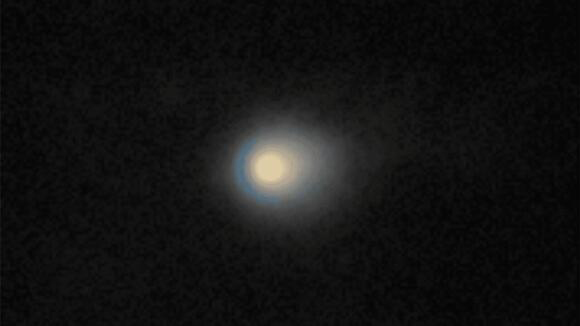
The third confirmed interstellar visitor, 3I/ATLAS, ignited a scientific and public controversy in mid–late 2025. Harvard astrophysicist Avi Loeb highlighted a cluster of unusual properties—size, trajectory alignment, weak gas detections at first, odd polarization, and timing of planetary encounters—arguing they are improbable if 3I/ATLAS were a typical natural comet. Other astronomers counter that available observations are consistent with a natural interstellar comet showing ordinary coma activity, cautioning against premature exotic interpretations. This post synthesizes what we know so far, fairly presents Loeb’s specific claims, summarizes the strongest counterarguments, and lays out concrete observations that can decisively resolve key questions.
Key sources cited and discussed:
- Avi Loeb’s recent essays on 3I/ATLAS anomalies and updates: Q&A, Anomalies recap, Preliminary view from Mars.
- Critical review by astronomer Jason Wright (AstroWright): Avi and 3I/ATLAS.
- Mainstream reporting and NASA-context overview: IFLScience.
- Media/podcast context with Loeb: The Good Trouble Show.
The original article drew on public discussion of Loeb’s claims alongside the sources above; those claims are presented as attributed proposals, not verified evidence of technology.
What is 3I/ATLAS?
- Third known interstellar object, discovered moving on a hyperbolic, retrograde trajectory through the Solar System in 2025 (after 1I/‘Oumuamua in 2017 and 2I/Borisov in 2019).
- Early estimates suggested a much larger apparent brightness than 1I/‘Oumuamua or Borisov, sparking debate about its nucleus size vs. coma contribution (reflective dust/gas envelope typical of comets).
- Multiple teams reported a visible “coma” (i.e., it looks like a comet), though the gas species detected (and timing of their detection) became part of the controversy.
Avi Loeb’s seven “anomalies” claim set
Loeb has articulated several reasons he believes 3I/ATLAS may be unusual enough to consider “technological artifact” scenarios alongside natural ones. Summarized from his recent essays:
- Size/mass scale: Loeb estimates a minimum diameter >5 km (implying mass orders of magnitude larger than 1I/‘Oumuamua), raising population-rate questions if objects this big are common in interstellar space [Loeb recap: anomalies 1–2, 7; see Hubble image discussion in his posts: anomalies recap].
- Jet morphology and timing: A Hubble image showed a forward-scattering jet and only a weak tail initially; Loeb views the geometry and evolution as atypical [ibid.].
- Composition claims: Early reports suggested CO2-dominant outgassing and nickel/iron ratios he likened to engineered alloys (if verified), plus unusually strong negative polarization [ibid.].
- Orbital geometry: Path aligned to the ecliptic within ~5° (Loeb estimates ~0.2% random probability) and “optimized” flybys near Mars, Venus, and Jupiter (claimed ~0.005% likelihood) [ibid.].
- Directional coincidence: Arrival direction allegedly near the famous 1977 “Wow! signal” beam (Loeb estimates ~0.6% chance alignment) [ibid.].
- Communications/data lag: Loeb has publicly noted a “media blackout” feel after the Mars flyby window; he attributes some delay to data pipelines (including U.S. government shutdown effects) rather than conspiracy, while still pressing for releases [Loeb Q&A: Q&A].
Loeb’s bottom line: While natural explanations may still prevail, he argues the aggregate improbabilities justify keeping “technological” hypotheses on the table and prioritizing targeted observations.
The counterarguments from planetary astronomers
A number of professional astronomers argue there is no compelling evidence that 3I/ATLAS is anything but a natural comet; they point to several issues in the “anomalies” narrative:
- Clear coma detection: Multiple large telescopes tracked 3I/ATLAS non-sidereally (i.e., tracking the object, letting stars trail), showing an extended coma consistent with a comet. Wright stresses this undermines arguments that apparent fuzz is just motion smear [AstroWright: Avi and 3I/ATLAS].
- Early lack of strong gas lines is expected: At >4 AU, H2O sublimation is weak; CO/CO2-driven activity can dominate without the usual visible-spectrum gas bands. This is normal comet behavior at large heliocentric distances, per comments cited by Wright from comet specialists (e.g., Licandro) [AstroWright updates within the same post].
- “It looks like a comet” (NASA view): NASA’s small-bodies lead Tom Statler characterized the object’s behavior as strongly comet-like; reporting emphasizes that cumulative data fit a natural comet interpretation [IFLScience summary: IFLScience].
- Probability claims are delicate: Apparent “improbabilities” (ecliptic alignment, timing of encounters) require careful treatment of selection effects and prior assumptions. The Solar System geometry, survey biases, and the fact we pay attention to notable alignments after the fact can inflate perceived oddities. Wright also notes that Loeb sometimes doesn’t incorporate existing dynamical literature in early blog-stage arguments [AstroWright: Avi and 3I/ATLAS].
Counter-bottom line: So far, observations are consistent with a large, fast interstellar comet exhibiting expected behavior at its distances and phases—interesting and valuable, but not evidencing technology.
Where the evidence stands right now
- Coma: Multiple independent teams reported a coma. This strongly favors “comet.” The morphology (forward-scattering jet vs. classic tail) needs unified analysis across filters/phase angles.
- Composition: Claims of CO2-dominant outgassing and unusual Ni/Fe require peer-reviewed, instrument-calibrated spectroscopic results with uncertainties and cross-team replication.
- Polarization: “Extreme negative polarization” would be noteworthy; we need consistent polarimetric datasets and comparisons to known comets at similar phase angles and dust properties.
- Dynamics/geometry: Claims of extraordinary alignment probabilities must be computed with appropriate priors (e.g., arrival-direction distributions for interstellar objects), survey selection biases, and proper accounting of a posteriori inferences.
- Mars/Earth data: Loeb expects HiRISE/MRO, MAVEN/IUVS, Mars Express/HRSC+OMEGA+SPICAM, TGO/CaSSIS+NOMAD, Tianwen-1/MoRIC, EMM/EXI+EMIRS+EMUS, etc., to tightly constrain nucleus size, coma properties, and composition [Loeb Q&A and previews: Q&A, Preliminary view].
Until those datasets are public with methods and uncertainties, arguments based on preliminary images or non-public briefings should be treated as provisional.
An open-minded, scientific way to frame the hypotheses
We can construct a simple hypothesis ladder and ask: “What observations would move probability mass up or down these rungs?”
- H1 Natural interstellar comet (ordinary): Early coma detection, CO/CO2 activity at large distances, polarimetry within known comet ranges, plausible nucleus size (<~10 km), dynamics consistent with interstellar populations.
- H2 Natural interstellar comet (unusual subclass): Atypical dust/jet geometry, unusual polarization for known analogs, uncommon volatile ratios (but still within natural comet chemistry), nucleus on the larger end of interstellar expectations.
- H3 Natural non-cometary (asteroidal/devolatilized) with dusty envelope from impacts/spallation or exotic refractory chemistry (less favored given coma reports).
- H4 Technological artifact (passive debris or inactive probe): Would require lack of volatile signatures with reflective dust mimics, or precise non-gravitational maneuvers without outgassing signatures.
- H5 Technological artifact (active): Clear, sustained non-gravitational accelerations decoupled from outgassing; engineered spectral/emissivity features; artificial radio emissions; structured fragmentation/releases synchronized with solar geometry.
In a Bayesian sense, H1/H2 start with higher priors because natural comets are known to exist and interstellar comets are now known (2I/Borisov). Extraordinary claims (H4/H5) require strong, multipronged evidence that is difficult to imitate by known natural physics.
What would decisively change minds? A measurement roadmap
To give both sides a fair test, the following measurements—some already in progress—would be game changers:
High-resolution nucleus constraints
- HiRISE/MRO imaging: Even upper limits on nucleus FWHM can constrain size; brightness modeling with phase-angle-dependent scattering separates nucleus vs. coma contributions [anticipated by Loeb: Preliminary view].
Spectroscopy across bands
- UV/visible/IR spectra (MAVEN IUVS, OMEGA, SPICAM, NOMAD, ISEM, EMIRS/EMUS): Look for CN, OH, C2, CO, CO2, H2O lines/bands and their evolution with heliocentric distance. Robust detections of typical cometary volatiles favor H1/H2.
- Elemental/ionic lines: Claims about Ni/Fe must be backed by calibrated line identifications and abundance modeling compared to solar/comet baselines.
Polarimetry and dust physics
- Phase-resolved polarimetry to test “extreme negative polarization” vs. known comet families; Mie/aggregate dust models can constrain grain size distributions and composition.
Dynamics and potential non-gravitational forces
- Fit precise astrometry with outgassing momentum terms. If significant accelerations occur without compatible gas/dust activity, that elevates H3/H4/H5.
Radio/communications checks
- Coordinated radio SETI campaigns and passive monitoring during key geometry windows. A null result doesn’t prove natural origin, but a positive detection would be transformative.
Jet morphology modeling
- Forward-scattering jets are not unheard of; phase function plus particle size distributions can produce strong forward scattering. Multi-epoch imaging can test whether jet behavior maps onto known comet physics.
About the “hidden from the public” concern
- Loeb himself attributes much of the perceived delay to normal (and sometimes frustrating) realities: data calibration pipelines, mission operations cadence, publication review, and even a U.S. government shutdown interfering with routine communications [Loeb Q&A: Q&A].
- While it’s appropriate to ask for timely releases, extraordinary claims about deliberate suppression should be tethered to documented evidence. Historically, large mission teams often take weeks to months to release vetted products, even for high-profile targets.
How strong are the probability arguments?
- Ecliptic alignment: Loeb estimates a few tenths of a percent chance if directions are random and isotropic relative to the ecliptic [Loeb Q&A; anomalies recap]. But interstellar interlopers trace the Galaxy’s kinematics and local velocity ellipsoid, not a uniform sky distribution in ecliptic coordinates. Prior work on interstellar object (ISO) arrival distributions suggests broad directional dispersions; translating those into ecliptic-inclination priors is non-trivial and must include survey selection biases (we are more likely to discover objects on certain apparent paths/brightness evolutions). This makes “improbability” claims sensitive to model assumptions.
- Planetary flyby timing: “Optimized” flybys sound striking, but again require careful a priori modeling. Many grazing paths will have some planet-crossing proximities simply due to orbital architecture. A robust p-value must be computed from a forward-modeled ISO population plus the actual survey cadence and detection thresholds.
- Directional coincidence with “Wow! signal”: A few degrees’ proximity can happen by chance on a sky with many potential target directions and many notable historical directions. Absent an actual signal now associated with 3I/ATLAS, this rests in the realm of “interesting coincidence” but not evidence.
Takeaway: Probability arguments can be a starting point for curiosity and prioritization, but they are not substitutes for direct physical measurements.
Where Avi Loeb’s perspective is valuable—and where caution is warranted
Valuable:
- Pushing for “decision-quality” observations now rather than post-mortems later.
- Articulating testable predictions (e.g., non-gravitational acceleration without outgassing, composition diagnostics).
- Keeping open the space of possibilities when anomalies cluster.
Caution:
- Some early claims have leaned on incomplete or misinterpreted observational contexts (e.g., coma vs. tracking smear) as noted by planetary astronomers [AstroWright critique: Avi and 3I/ATLAS].
- Probability framings can be persuasive but fragile to prior/selection assumptions; they should not outweigh direct measurements.
- Communicating “threat” framings (e.g., “Trojan Horse”) can outpace evidence and create public misunderstanding.
Being open-minded is compatible with being rigorous: we can hold multiple hypotheses in mind while imposing high evidentiary standards for extraordinary ones.
What the UTP community should watch for next
- Public releases from Mars-orbiting missions (HiRISE/MRO, MAVEN, Mars Express, TGO), Tianwen-1, and the Emirates Mars Mission—especially nucleus size constraints, coma morphology, and gas detections.
- Peer-reviewed spectroscopy with line identifications, S/N, and cross-team replications.
- Refined astrometry testing for non-gravitational accelerations and outgassing modeling.
- Phase-resolved polarimetry series with comparisons to known comets.
- Any coordinated radio observations during advantageous geometries.
If these data show a typical comet in every measurable way, the controversy should cool—with 3I/ATLAS remaining a scientifically rich, natural interstellar comet. If they instead show sustained departures from natural expectations, the case for an engineered origin will warrant renewed, serious scrutiny.
Sources and further reading
- Avi Loeb: New Questions and Answers About 3I/ATLAS
- Avi Loeb: A Recap of the Anomalies of 3I/ATLAS
- Avi Loeb: A Preliminary View of 3I/ATLAS from Mars
- Jason Wright (AstroWright): Avi and 3I/ATLAS
- IFLScience overview (incl. NASA perspective): NASA Responds To Claims…
- The Good Trouble Show (context/interview): Avi Loeb on 3I/ATLAS
Metadata
- Title: 3I/ATLAS: Interstellar Visitor, Scientific Controversy, and the Data That Will Decide
- Excerpt: A rigorous, open-minded review of the 3I/ATLAS debate—Avi Loeb’s anomalies, astronomers’ counterarguments, and the exact observations that will settle the question.
- Tags: Interstellar Objects, 3I/ATLAS, Avi Loeb, Comets, Planetary Science, Spectroscopy, Polarimetry, SETI, MRO/HiRISE, MAVEN, Mars Express, TGO
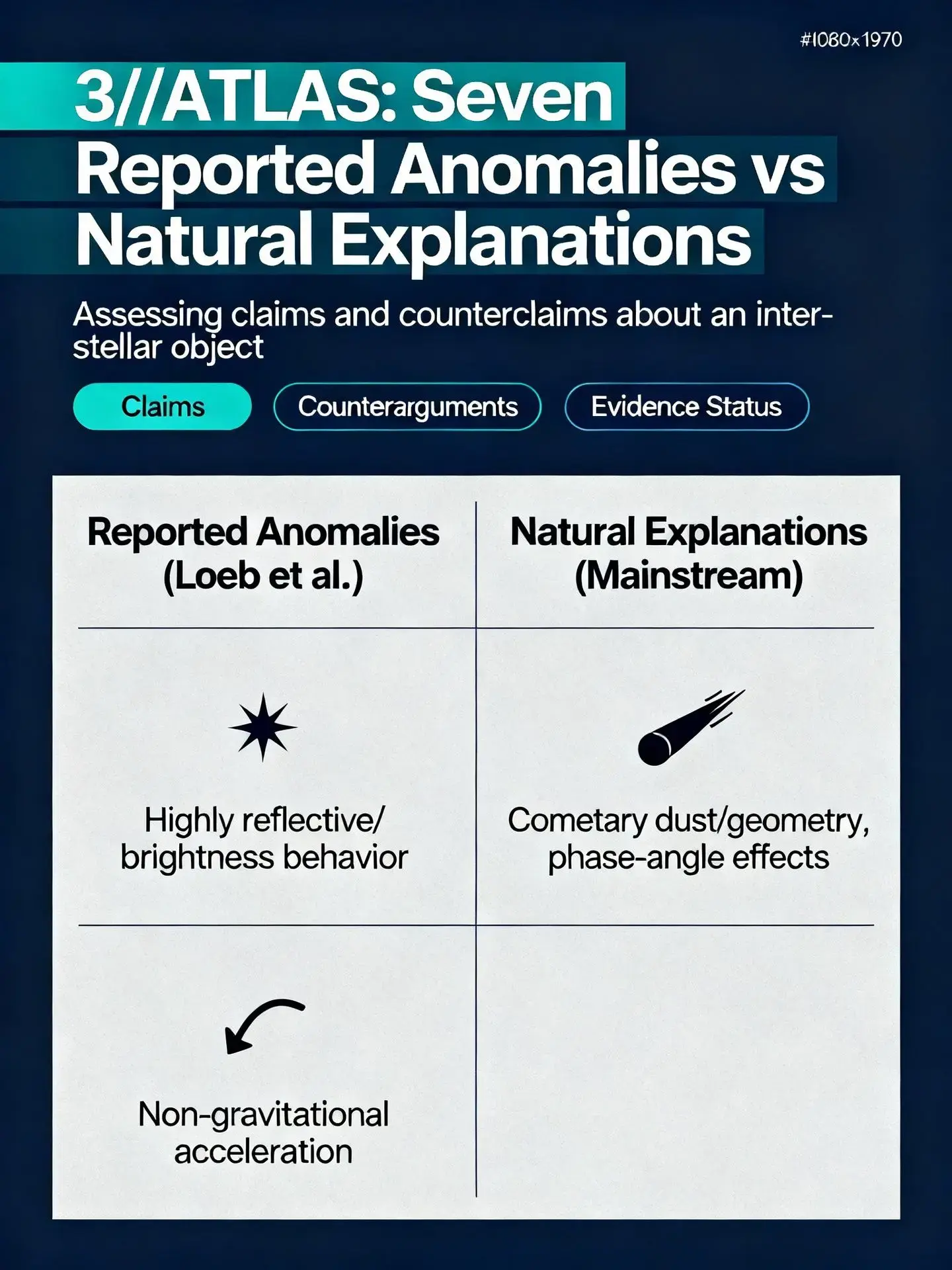
3I/ATLAS: What Do The Anomalies Really Mean?
Assessing claims and counterclaims about an interstellar object
The 3I/ATLAS controversy centers on whether a set of reported “anomalies” indicates a natural interstellar object behaving in uncommon ways—or something non-natural. Below is a concise synthesis of claims (largely highlighted by Avi Loeb et al.) and mainstream counterarguments from planetary scientists and observers.
Key takeaway: Current evidence does not compel a non-natural conclusion; several natural explanations remain plausible pending better data.
Seven Reported Anomalies vs Natural Explanations
- Brightness/reflectivity behavior — Cometary dust, geometry, and phase-angle effects can mimic high reflectivity.
- Non-gravitational acceleration — Outgassing jets/sublimation remain viable; radiation pressure bounds are not decisively exceeded.
- Unusual light curve/shape — Tumbling, elongated or contact-binary shapes, and albedo variegation explain light-curve complexity.
- Low inferred mass density — Porous cometary nuclei or rubble piles are consistent with known small-body physics.
- Lack of obvious coma/volatile signatures — CO/CO₂-dominated outgassing can be faint or missed at poor SNR/wavelengths.
- Entry velocity and trajectory — Within expected interstellar kinematics when accounting for selection effects.
- Thermal behavior constraints — Sensitive to conductivity and rotation assumptions; current constraints have large uncertainties.
Evidence status: Green = well-explained by natural physics; Yellow = plausible; Gray = uncertain/needs data.
What We Still Need
- Multi-band spectroscopy
- High-cadence photometry
- Independent thermal modeling
- Repeat observations with next-gen surveys (e.g., Rubin/LSST)
- Open data releases and peer review
Note: This page synthesizes published claims and critiques. We encourage rigorous, transparent analysis and replication.
Live Sidebar
Tracking upcoming datasets
- Mars orbiter data reprocess: pending
- Survey cross-matches: planned
- Thermal model preprint: awaiting review
Downloads
- 1-page 3I/ATLAS brief (DOCX)
- UFO Investigation Protocol checklist (DOCX)
Status Legend
Well-explained
Plausible
Uncertain