


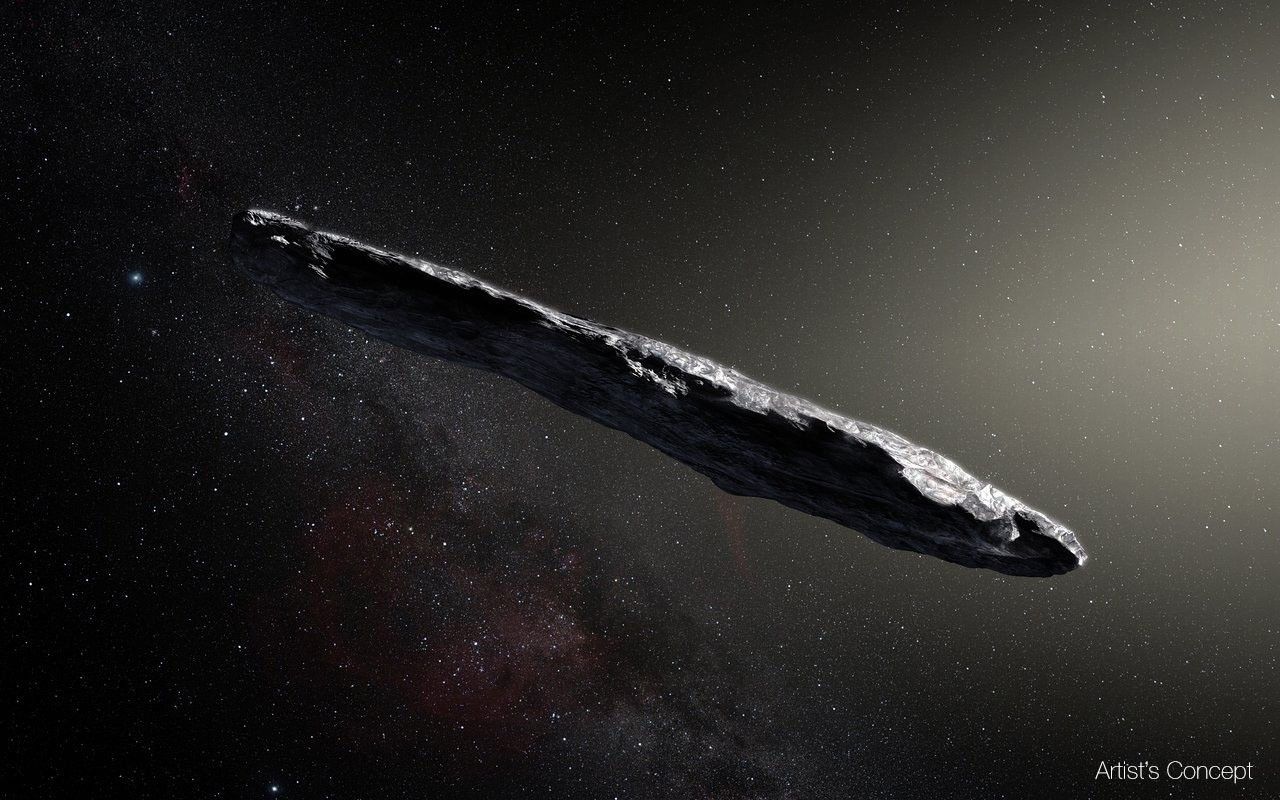
The most famous picture of ʻOumuamua is not a photograph of ʻOumuamua. It is an artist’s impression—a striking reconstruction of something astronomers observed only as a distant point of light. Yet behind that imagined shape lies a genuine discovery: an object from beyond our Solar System, passing through on a trajectory that did not quite follow gravity alone.
If the Black Knight satellite legend asks whether alien hardware might be hiding in space, ʻOumuamua offers a more grounded version of that question: could an actual interstellar visitor be artificial? That possibility has been explored in a published scientific paper. It has not been established by the observations.
This is an informed exploration of the alien-probe hypothesis alongside natural explanations. The object’s existence and interstellar origin are established; its identification as extraterrestrial technology is not.
A Real Visitor—Not the Black Knight Satellite
The distinction is essential. ʻOumuamua is not a confirmed version of the legendary Black Knight, and there is no demonstrated connection between them. It did not orbit Earth as an ancient satellite: it travelled through the Solar System on an unbound path. Their connection is thematic—the possibility of nonhuman technology in space—not a shared identity, orbit or history.
For the historical legend and its separate evidence, see Black Knight Satellite Mystery: Ancient Alien Probe or Space Debris? The Evidence Explained.
What Astronomers Actually Discovered in 2017
On October 19, 2017, the Pan-STARRS1 telescope in Hawaiʻi discovered the object now designated 1I/ʻOumuamua. It had already passed its closest point to the Sun on September 9. Follow-up observations established a hyperbolic, unbound trajectory: it was not a normal member of the Sun’s family of planets, asteroids and comets.
Its orbit made it the first confirmed interstellar object observed passing through our Solar System—not the first such object ever to visit. Earlier visitors could easily have escaped detection. NASA’s ʻOumuamua overview provides the discovery context.
| Evidence level | What it tells us | What it does not establish |
|---|---|---|
| Observed trajectory | Interstellar origin and an unbound passage | An intentional destination or controlled flight |
| Changing brightness | Constraints on shape, reflectivity and rotation | A resolved cigar, disc or spacecraft |
| Non-gravitational acceleration | A small additional force was needed to fit the orbit | Engines, piloting or artificial construction |
| No detected ordinary dust coma | Conventional visible comet activity was not detected | The absence of every possible form of gas release |
The Shape Mystery: Cigar, Disc or Something Else?
ʻOumuamua’s brightness varied dramatically as it rotated. A long body can present a large reflective area in one orientation and a narrow one in another. That helped inspire the familiar cigar-shaped depiction. But brightness is not a photograph: surface reflectivity, viewing geometry and complex rotation all influence a light curve.
Later modelling admitted both elongated and flattened solutions. Mashchenko’s 2019 light-curve study favoured a disc-like solution under its assumptions. This does not establish a flying saucer; it shows why the exact geometry remains uncertain. The supplied illustration is one possible visual interpretation, not evidence of a hull, metal surface or engineered structure.
The Unexpected Acceleration
The most important anomaly was not a dramatic turn or a visible burst of speed. Its trajectory departed slightly from the path predicted by gravity alone. Micheli and colleagues’ 2018 Nature paper measured this non-gravitational acceleration and favoured comet-like outgassing as its physical explanation.
Sunlight can warm volatile material and release gas. That escaping gas supplies a recoil force, rather like a very weak natural thruster. The difficulty was that ʻOumuamua did not show the conspicuous dust coma or conventional activity expected from a familiar comet. Reconciling the measured push with the observations became the heart of the debate.
The acceleration is a real measurement. Calling it a deliberate manoeuvre adds a claim the measurement itself does not support.
Could It Have Been an Alien Light Sail?
In 2018, Shmuel Bialy and Avi Loeb explored whether radiation pressure from sunlight could explain the acceleration. Their Astrophysical Journal Letters paper considered a very thin object with a sufficiently large area relative to its mass, including an artificial light-sail possibility.
The idea is physically motivated: light carries momentum. A sufficiently lightweight sheet can be pushed by sunlight without releasing a visible cometary tail. The paper discussed a mass-to-area ratio around 0.1 grams per square centimetre and sub-millimetre thickness under its thin-sheet assumptions. These were model requirements—not measured dimensions of ʻOumuamua.
Even within a technological scenario, an active probe and passive technological debris would be different explanations. Showing that a hypothetical sail could experience the measured force does not show that this object was a sail, was manufactured, or was visiting us intentionally. No verified artificial signal or resolved engineered feature established that interpretation.
Natural Explanations Deserve the Same Careful Examination
A 2019 multidisciplinary review concluded that the observations were consistent with a natural origin. That conclusion does not mean every physical detail was solved. It means the evidence did not require extraterrestrial engineering.
One later proposal is particularly interesting. Bergner and Seligman’s 2023 Nature paper suggested that cosmic rays could generate molecular hydrogen within water-rich ice during interstellar travel. Solar heating could then release trapped hydrogen, providing recoil without a readily visible dusty tail.
That is not the same as proposing a body made of pure hydrogen ice. Nor is it a closed case: Ligterink’s published critique questioned whether enough hydrogen could be produced, while the authors’ reply defended the mechanism’s viability within uncertainties. Other proposals involving unusual ices, fragments and radiation-pressure effects also face physical constraints.
Two shortcuts should be avoided: ‘a natural model exists, so the mystery is completely solved’ and ‘a natural model has difficulties, so aliens are confirmed.’ Neither follows. A good explanation must account for the observations together—not only the feature it was designed to explain.
Other Objects Like It: Borisov and 3I/ATLAS
We now have other confirmed interstellar visitors to compare with ʻOumuamua. Their existence makes a population of objects drifting between stars less abstract. It does not demonstrate a population of probes.
| Object | Discovery | Why it matters |
|---|---|---|
| 1I/ʻOumuamua | October 19, 2017 | Unusual light curve and non-gravitational acceleration without a detected ordinary dust coma |
| 2I/Borisov | August 30, 2019 | Clearly active interstellar comet; a natural comparison with distinctive chemistry |
| 3I/ATLAS | July 1, 2025 | Third confirmed interstellar visitor, with observed cometary activity |
2I/Borisov displayed a visible coma and natural cometary behaviour. Its chemistry was still scientifically interesting: an unfamiliar composition does not automatically imply an artificial material.
NASA describes 3I/ATLAS as an interstellar comet. JWST spectroscopy reported a carbon-dioxide-dominated coma alongside water, carbon monoxide, water ice and dust. Measurements of gas in a coma are not direct measurements of the entire nucleus, but they provide tangible evidence of cometary activity.
Our companion article, 3I/ATLAS: A Scientific Deep-Dive Into An Interstellar Controversy, examines the arguments that emerged around that later visitor. It is preserved as an October 2025 account of the debate, not presented as a fresh 2026 observational update.
The important comparison is not ‘three visitors, therefore three alien spacecraft.’ It is that interstellar objects can differ substantially. Better samples could tell us whether ʻOumuamua represents an unusual natural class, a common class we have barely seen, or something requiring a different explanation.
What Would Make the Probe Hypothesis Stronger?
- Repeatable artificial signals reliably localised to the object, with interference and natural emission excluded.
- Resolved structural or material evidence that is difficult to reproduce through known natural processes.
- Precisely measured behaviour inconsistent with gravity, radiation pressure and physically plausible outgassing—not simply another unexplained residual.
- Independent confirmation from multiple instruments, with accessible data, uncertainties and explicit tests of competing explanations.
No single checklist item is a guarantee of alien technology. The case would need converging evidence. An unusual shape, an interesting alignment or a null search for radio signals cannot settle it alone. Likewise, a quiet or inactive hypothetical probe would not necessarily transmit—but that possibility does not become positive evidence merely because it is hard to exclude.
The Mystery Worth Keeping Open
ʻOumuamua was real, genuinely interstellar and scientifically unusual. It is a much firmer starting point for discussion than an unverified ancient Earth satellite. But ‘real object’ and ‘real alien probe’ remain different propositions.
The artificial-origin hypothesis is worth describing accurately and testing where possible, not elevating into a discovery announcement. Natural explanations remain viable, while the exact shape, composition and acceleration mechanism are incompletely constrained. The most productive next step is to catch future interstellar visitors earlier, measure them better, and let observations—not the appeal of either conclusion—decide.
Sources & Further Reading
- NASA — ʻOumuamua discovery and overview
- Micheli et al. (2018) — Non-gravitational acceleration in the trajectory of 1I/2017 U1 (ʻOumuamua)
- Bialy & Loeb (2018) — Could Solar Radiation Pressure Explain ʻOumuamua’s Peculiar Acceleration?
- ʻOumuamua ISSI Team (2019) — The natural history of ʻOumuamua
- Mashchenko (2019) — Modelling the light curve of ʻOumuamua
- Bergner & Seligman (2023) — Acceleration of 1I/ʻOumuamua from radiolytically produced H₂ in H₂O ice
- Ligterink (2023) — Hydrogen-production critique
- Bergner & Seligman (2023) — Reply to the critique
- NASA — 2I/Borisov
- NASA — 3I/ATLAS facts and FAQs
- NASA Technical Reports Server — JWST observations of 3I/ATLAS’s coma