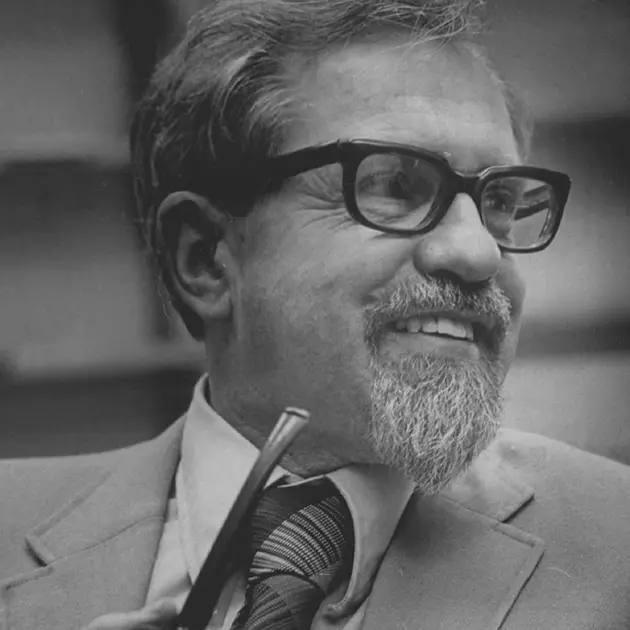
Josef Allen Hynek (May 1, 1910 – April 27, 1986) was an American astronomer, professor, and ufologist.[1] He is perhaps best remembered for his UFO research. Hynek acted as scientific advisor to UFO studies undertaken by the U.S. Air Force under three projects: Project Sign (1947–1949), Project Grudge (1949–1951) and Project Blue Book (1952–1969).
J. Allen Hynek began as a cautious skeptic and ended as the scholar who gave UFO research a credible vocabulary. An American astronomer, professor, and eventually ufologist, Hynek served as the scientific advisor to the U.S. Air Force’s three major UFO study programs. Over four decades, he helped transform public and scientific discourse around unidentified aerial phenomena, moving it away from tabloid fodder toward a more careful, data-driven inquiry. He is best known for formalizing the “Close Encounter” classification system and for founding the Center for UFO Studies (CUFOS), institutions and ideas that still frame the field today.
Early Life, Esoteric Curiosity, and Academic Ascent
- Born in Chicago to Joseph (a Czechoslovak immigrant and cigar manufacturer) and Bertha (a grammar school teacher), Hynek’s first brush with astronomy came unexpectedly. At age seven, bedridden with scarlet fever and starved for reading material, he devoured a high school astronomy textbook that his mother brought to pass the time.
- In high school, he excelled in mathematics, edited the school paper, and developed an interest in esoteric traditions—reading Rosicrucian texts and Rudolf Steiner’s works. While he remained a rigorous empiricist throughout his career, this early curiosity primed him to engage thoughtfully with phenomena at the margins of accepted science.
- Hynek studied astronomy at the University of Chicago before joining Ohio State University, where he eventually directed the McMillin Observatory. His mainstream academic career included authoritative work in stellar spectroscopy and education, and he later chaired the Department of Astronomy at Northwestern University.
Enter the Air Force: From Skeptic to Structured Investigator
- In 1948, amid a wave of postwar sightings—including the famous Kenneth Arnold “flying saucers” report over Washington’s Cascade Mountains—Hynek agreed to assist the Air Force’s Project Sign as its astronomical consultant.
He approached the problem like a taxonomist of error:
- Astronomical sources (meteors, Venus, star scintillation)
- Meteorological/optical phenomena (lenticular clouds, mirage, temperature inversions)
- Man-made objects (balloons, aircraft, satellites)
- Residual cases (unidentified after competent investigation)
- Roughly 20% of cases resisted prosaic explanations. Hynek initially expected that better data would cleanly resolve this residue. But the residue persisted.
- Astronomical sources (meteors, Venus, star scintillation)
- Meteorological/optical phenomena (lenticular clouds, mirage, temperature inversions)
- Man-made objects (balloons, aircraft, satellites)
- Residual cases (unidentified after competent investigation)
Grudge to Blue Book: The Evidence Gets Stranger
- Under the successor programs—Project Grudge and later Project Blue Book—Hynek gained more latitude for field investigation and interaction with witnesses. His attitude evolved: he remained skeptical of extraordinary claims but became increasingly impressed by observers who were trained, calm, and technically literate (pilots, police, radar operators).
Key turning points:
- Lonnie Zamora (Socorro, 1964): A respected New Mexico police officer reported a close-range sighting of an oval craft and occupants with landing traces and scorched brush. Hynek later cited Socorro as a case that challenged simplistic dismissals.
- March 1966 Michigan sightings: Under intense media pressure, Hynek floated “swamp gas” as a possible explanation for some nocturnal lights. The phrase became a national punchline—yet the political fallout prompted Congressman Gerald Ford to push for Congressional hearings. Hynek used the spotlight to call for open, rigorous research, marking his first public break with Air Force minimization tactics.
The Condon Disappointment and Turning Point
- Hynek welcomed the formation of the University of Colorado’s Condon Committee (1966–1968), anticipating an honest scientific appraisal. The final report recommended against further government study, effectively ending Project Blue Book in 1969.
- Privately, Hynek was dismayed; he felt the report overlooked high-quality unexplained cases and stifled curiosity within academia. Freed from official constraints, he pivoted to independent research.
Building a Science of UFOs: CUFOS and the “Invisible College”
- In 1973, Hynek founded the Center for UFO Studies (CUFOS) in Chicago, aiming to professionalize data collection, elevate case analysis, and collaborate with law enforcement. He cultivated an informal network of academics and investigators he called the “invisible college”—serious scholars willing to study UFOs without risking professional backlash.
Hynek’s methodological contributions:
The Close Encounter scale
- Nocturnal lights (NL), daylight discs (DD), radar-visual (RV)
- Close Encounters of the First, Second, and Third Kind (CE-I, CE-II, CE-III), later expanded (e.g., CE-IV abduction typologies by others)
- Emphasis on trace evidence, multisensor corroboration (e.g., radar-visual), and witness credibility assessment
- Advocacy for standardized forms, chain-of-custody for physical samples, and interdisciplinary teams
- Nocturnal lights (NL), daylight discs (DD), radar-visual (RV)
- Close Encounters of the First, Second, and Third Kind (CE-I, CE-II, CE-III), later expanded (e.g., CE-IV abduction typologies by others)
Obscure and Underappreciated Details
- Hynek’s early debunking reputation: In the 1950s, he publicly emphasized conventional explanations. This earned him the ironic title “Father of the Swamp Gas,” which he later regretted. The contrast between early debunker and later advocate for serious study is central to understanding his intellectual journey.
- The “Hynek UFO Report” and evolving tone: His writing style shifted from categorical skepticism toward measured agnosticism. He coined the term “UFO” not as an alien placeholder but as a neutral label for an observational problem—a category error in public discourse he tried to correct repeatedly.
- Collaboration with Allen Hendry: CUFOS’s chief investigator in the late 1970s, Hendry authored The UFO Handbook (1979), reflecting Hynek’s push for disciplined case triage and the surprising persistence of high-strangeness residuals after competent filtering.
- Spielberg connection: Hynek’s Close Encounter taxonomy inspired the title of Steven Spielberg’s 1977 film Close Encounters of the Third Kind. Hynek himself makes a cameo near the end of the film—bearded, pipe in hand—appearing as the craft descends. The pop-cultural feedback loop boosted public interest and, paradoxically, increased the stigma within academia.
- The Project Starlight Scope rumor: Within UFO circles, there were claims that Hynek was privately briefed on classified night-vision/infrared UFO detections during the Vietnam War era. While documentation is thin and often anecdotal, it reflects the broader problem Hynek wrestled with: tantalizing leads trapped behind classification walls.
- The “Ohio State satellite” flap: Earlier in his academic career, Hynek drew criticism from colleagues who felt his public-facing UFO commentary risked overshadowing legitimate astronomical work. Hynek’s balancing act—maintaining academic standing while probing a taboo subject—was a continual, mostly invisible struggle.
- Magnetic and radiation anomalies: Hynek was among the first to argue that CE-II reports involving ground traces, electromagnetic interference, and physiological effects should be treated as testable hypotheses, not folklore. He encouraged site surveys, soil sampling, and instrumented follow-ups, predating modern “anomalous phenomena” field protocols.
- Private frustrations with Blue Book: Hynek confided that many Blue Book case assignments were under-resourced and time-limited, incentivizing quick explanations over thorough ones. He later called the Air Force’s approach “statistically neat but scientifically sterile.”
Philosophy of Inquiry: A Middle Path Between Belief and Debunking
- Hynek rejected both credulity and reflexive dismissal. His mantra was methodological humility: extraordinary claims demand extraordinary investigation, not merely extraordinary skepticism.
- He framed UFOs as a “signal in the noise” problem: most cases are noise, but the persistent residue of well-documented anomalies implies a real phenomenon worth studying—regardless of ultimate origin (natural, technological, psychological, or extraterrestrial).
He argued for:
- Open data sharing between civilian and military organizations
- Instrumented observation networks
- Cross-disciplinary collaboration (astronomy, atmospheric physics, psychology, electrical engineering)
- Longitudinal study of recurrent locales and witnesses
- Open data sharing between civilian and military organizations
- Instrumented observation networks
- Cross-disciplinary collaboration (astronomy, atmospheric physics, psychology, electrical engineering)
- Longitudinal study of recurrent locales and witnesses
Legacy: Institutions, Language, and a Standing Invitation to Science
- CUFOS continues to maintain archives and analytical standards aligned with Hynek’s vision.
- The Close Encounter schema remains ubiquitous in both scholarship and culture.
- Perhaps his most enduring contribution is epistemic: Hynek made it respectable to say “we don’t know—yet” and to treat that not as a weakness but as a starting point for science.
Reference Links:
Project Sign (1947–1949): Project Sign – USAF historical overview
Center for UFO Studies (CUFOS): CUFOS official site
Close Encounter classification system: Hynek’s Close Encounter scale (CUFOS overview)
University of Chicago (Hynek studied astronomy): Department of Astronomy & Astrophysics – UChicago
Ohio State University – McMillin Observatory: McMillin Observatory history (OSU)
Kenneth Arnold “flying saucers” report: [Kenneth Arnold 1947 sighting (FBI vault)]https://vault.fbi.gov/UFO/UFO%20Part%201%20of%2016/view
Lonnie Zamora (Socorro, 1964): Socorro case file (NICAP)
March 1966 Michigan sightings (“swamp gas”): Michigan 1966 sightings – contemporary coverage and reports
Gerald Ford’s call for hearings: Ford’s 1966 letter urging UFO hearings (Ford Library)
Condon Committee (University of Colorado): Final Report of the Condon Committee (full text)
Project Blue Book closure (1969): USAF statement ending Blue Book
“Invisible college” (Hynek usage/context): Historical discussion of the “invisible college” in ufology (Archived CUFOS/secondary)
Allen Hendry – The UFO Handbook (1979): WorldCat entry for The UFO Handbook
Spielberg cameo and influence: Hynek cameo in Close Encounters (American Film Institute)
Trace evidence/CE-II studies (overview): NICAP – Physical Traces Associated with UFO Sightings
Radar-visual cases (methodology emphasis): CSIRO/NICAP radar-visual case catalog (archival)
Hynek’s later reflections (“statistically neat but scientifically sterile”): Hynek interviews/quotes compilation (CUFOS/archival)
Conclusion: Hynek’s Third Way
J. Allen Hynek didn’t prove that UFOs are extraterrestrial. He proved that dismissing them wholesale is unscientific. Bridging the worlds of academia, government investigation, and public curiosity, Hynek carved a third way between belief and debunking: disciplined agnosticism. He showed that careful taxonomy, patient fieldwork, and respect for credible witnesses can turn an embarrassing topic into a legitimate research program.
His evolution—from the Air Force’s reluctant consultant to the architect of a scientific framework—mirrors the maturation the field still needs. Today’s debates over UAP sensors, pilot reports, and declassified footage echo the same issues that animated Hynek’s career: data quality, methodological rigor, and institutional transparency. The questions he posed remain open, but clearer, because he asked them well.
If the history of science teaches anything, it’s that anomalies are invitations. Hynek spent his life RSVP’ing on behalf of reason. The enduring challenge he leaves us is both modest and profound: collect better data, test better hypotheses, and keep the door open to whatever the universe is actually doing—no more, and certainly no less.
Share this post
Tags
Our blogs
Archive