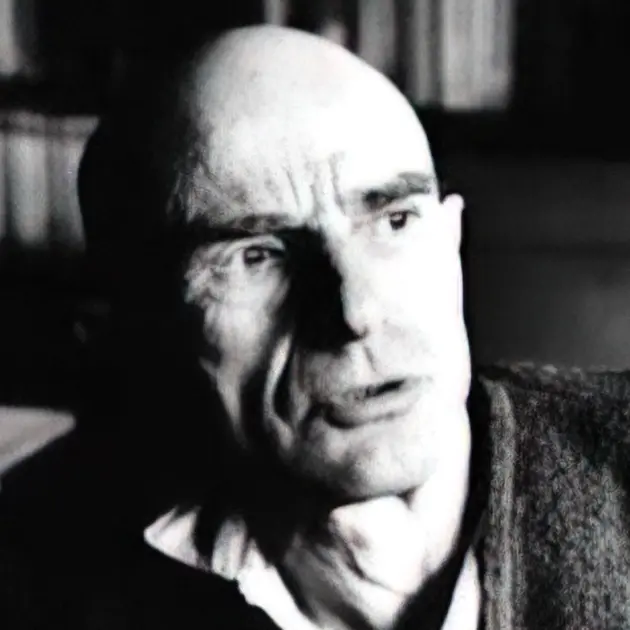

Aimé Michel (1919–1992) was a French writer and early UFO investigator whose work helped shift attention from individual encounters to the structure of entire sighting waves. With a background in philosophy and work in French radio, he approached the phenomenon as an intellectual problem that demanded both imagination and scrutiny. His enduring question was not simply “what did a witness see?” but “what relationships emerge when many reports are examined together?” See the biographical account preserved by GREPI.
The French Wave of 1954
The concentration of reports in France during autumn 1954 gave Michel material for an ambitious experiment: arrange sightings geographically and chronologically, then look for relationships between them. Rather than treating every account as an isolated mystery, he asked whether reports assigned to the same day formed a larger spatial pattern. This was an early attempt to make the catalogue itself an analytical instrument.
Orthoteny: The Straight-Line Hypothesis
Michel called the proposed alignments orthoteny. The best-known example, BAVIC, takes its name from Bayonne and Vichy. His argument became associated with Mystérieux objets célestes (1958), published in English as Flying Saucers and the Straight-Line Mystery. The Wellcome Collection catalogue records the English edition; GREPI preserves an overview of orthoteny. These were proposed relationships between reported locations, not verified flight paths or proof of an extraterrestrial origin.
When a Pattern May Be a Mirage
A map containing many points offers many opportunities to draw apparently meaningful lines. An alignment becomes scientifically interesting only if it exceeds what an appropriate chance model would predict. In his 1966 discussion, Michel addressed objections and Lex Mebane’s examination of chance alignments. In a 1970 reassessment, he discussed Toulet’s critique and accepted the practical conclusion that orthoteny might be a mirage, while disputing aspects of the argument.
The lesson is not that every spatial question is futile. It is that a compelling visual arrangement is the beginning of a test, not its conclusion. Date uncertainty, imprecise locations, selected cases, repeated reports, population density and the number of patterns searched can all change the result. A modern analysis must preserve those uncertainties rather than letting a clean graph conceal them.
Michel and Jacques Vallée: A Shared Research Horizon
Michel and Jacques Vallée belong to a lineage of researchers who sought relationships across collections of reports. Their professional overlap is documented in Charles Bowen’s 1969 anthology The Humanoids, whose contributors include both men, as recorded by the Wellcome Collection. Vallée’s computer-assisted cataloguing extended the broader ambition of studying the phenomenon in aggregate; that does not make Michel’s particular alignments validated findings.
Selected Publications
- Lueurs sur les soucoupes volantes (1954): an early French book on flying-saucer reports.
- Mystérieux objets célestes (1958): the work associated with orthoteny and the French sighting wave; its English edition is titled Flying Saucers and the Straight-Line Mystery.
- Contributor to The Humanoids, edited by Charles Bowen (1969): a collection examining reported encounters and their research context.
Why Michel Matters to UFO AI Analytics
Michel’s contribution is a research instinct, not a settled answer: look beyond the dramatic case and ask what the archive can reveal collectively. Today that means comparing distributions, testing alternative explanations and documenting how the data was assembled. AI can help organize reports and surface candidate relationships, but it cannot turn selection bias or incomplete testimony into reliable evidence merely by producing a sophisticated chart.
The UFO Timeline Project’s UFO AI Analytics and AI UFO Pattern Lab take up that question with a small, explicitly illustrative dataset while the larger archive is developed. Michel’s work reminds us to preserve the courage to ask an unusual question—and the discipline to abandon an attractive answer when it fails a fair test.
Sources and Research Context
- GREPI — biographical account of Aimé Michel
- Institut Métapsychique International — works on Aimé Michel (French)
- Wellcome Collection — Flying Saucers and the Straight-Line Mystery catalogue record
- Michel’s 1966 discussion of the problem and chance alignments
- Michel’s 1970 reassessment: Orthoténie, réalités et illusions
- Wellcome Collection — The Humanoids, contributors and publication record
This is an original UTP research profile, not a reproduced article from the former site. Bibliographic records establish publications; historical hypotheses remain distinct from verified findings.